Wednesday, September 30, 2015

Here vs There

It's been another trip back, another time warp and culture shock.  I left the field on Thursday, September 10th, then stopped in Juba, Paris, and New York before returning to San Francisco.  I had a full weekend in Paris, taking my first hot shower and walking alone.  I re-learned how to cross streets, enjoyed the convenience of supermarkets and reveled in the abundance of the farmer's market.  Then it was on to New York, with a one-week pause to see family and friends.  I ended up sleeping in a different place every night for 8 nights running, which was a bit of an adventure.  Then it was back to the West Coast, adding another few hours onto the jetlag, and increasing my already-six-month-long sleep debt.  Time for some relaxation.

Every time I return, I'm struck by certain differences.  Last time, the technological gap seemed to me like time travel.  This time, I'm really noticing the fashion and beauty standards of the two very disparate places that I live.  Coming back, I feel that everyone here tries to be the same.  As I take the bus in San Francisco, up into the Marina District, the stereotypical Marina Girl populates the bus.  They have tight black yoga pants, a slouchy I-don't-care shirt, long gorgeous brown hair that costs a lot of money, a trendy phone in a cute case, ear phones, and makeup.  I see them in a row, and I wonder what the story of each of their lives is like.  I cannot fathom that they are each individuals.  It's shocking to see this drive to homogeneity, in a society teaching every millennial "you're special," "you're unique," "you're a pretty snowflake."  And many millennials strive toward the current flavor of beauty or perfection, turning themselves into indistinguishable dolls.

Coming back from Aweil, South Sudan, this is shocking to me.  In Aweil, many people have never seen themselves.  Open water is too muddy to provide a clear reflection.  There aren't too many mirrors.  Our security rules prohibited the taking of photos, but for my work, I needed to take pictures of construction works.  I would try to avoid taking pictures of any person, since getting their permission is time-consuming.  I'm just trying to take a picture of that latrine pit, excuse me.  Sometimes, though, children would see us taking pictures of construction works, and clamor for a picture.  They would grab the phone and turn it around and stare at it.  When I took a picture of the progress of a pit being dug, the workers asked me to print out the picture.  I brought it the next day and gave it to them.  Eight grown men stopped work and clustered around.  They stared at themselves.


People live a difficult life, and it is apparent in their appearance.  Aside from being gaunt, they are scarred (many ritually, with tribal identification scarification) and sometimes disfigured.  Missing eyes or limbs are not extraordinarily uncommon.  People are stamped with the journey of their life.  They are individuals, and show on their faces the times they have been through.  They are self-conscious to different beauty standards.  Much stake is given to someone's appearance and clothes. Shoe-shine boys wander the streets, making their living in polishing the population's shoes.  Everyone has their shoes shined.  Men wear button-down shirts, neatly pressed and laundered.  Perhaps they are threadbare and torn at the seam, but they are clean and neat.  Women wear clothes with a vibrant and colorful fabric wrap tied around their shoulders, adding splashes of color to the market.  They do their hair and style it, or wear wigs and keep their head shaved for convenience.  But no one is fixing their face.  No one is changing their appearance to look more like a beauty standard of the country.  There is no body sculpting, no plastic surgery, no make up.  No journey towards a perfect beauty standard to make everyone homogeneous.


But maybe that's because they don't yet have the resources for it?

I'd say to show your scars, be yourself.  You're beautiful the way you are.

Stumble Upon Toolbar

Sunday, August 30, 2015

This Week Requires Documentation

Many of my posts are day-in-the-life posts, which I write after a particularly crazy stretch of activity.  Sometimes I'm struck with the thought, "This is too crazy; I have to tell someone."  Sometimes those days are memorable, like when key personnel were on vacation, a team got stuck on the other side of the river as the ferry broke down, and a cholera outbreak was just announced in the western part of the country; or when riding along on a vaccination campaign.  Sometimes, they're not particularly memorable but distill the amount of activity of a project into one encapsulated story.

This week was an example of ludicrously high levels of activity, where I kept asking, "Is this a joke?  Candid camera? The Truman Show?  It's a test.  It's gotta be a test."

Some background: I'm the logistics referent at a project in South Sudan for MSF.  I coordinate the logistic activities (operations, maintenance, infrastructure, engineering, supply, this sort of thing) for a 200-bed hospital, including warehouse/pharmacy complex, office, and housing for 25 expats.  My team is divided into 3 branches (base, hospital, and supply).  We're 100 logistic staff, all together.  We have been short one manager for the past 5 months.  Sometimes that's a base manager, sometimes it's a hospital manager, sometimes it's a supply manager.  The team here has had to fill gaps for a long time, and since supervisors are responsible for keeping the day-to-day activities running, it falls to me to replace the managers.  After all, I'm here in pure support.  I do quality control, training, and coordination, but no actual management or tasks.  In my job as log ref, I don't actually do work, I like to say.

This week was the perfect storm of ridiculousness.  Last week was the visit of the Logistics Coordinator from the capital, and the Logistics Supervisor from headquarters.  It's a big visit, so I was preoccupied with them.  There is no hospital log at the moment, so I was covering that position, plus doing my job, plus hosting those two.  Needless to say, this took a lot of energy, and the team was tired from a big visit, plus pulling more weight than usual.  We also had my going-away party on Saturday, since I'm leaving (inchallah) in another couple of weeks, which was another load on our department.

Monday starts with dismantling tents and recovering from the party, but quickly escalates.  The AC technician flying in from Juba, for his quarterly maintenance of the project's air conditioners.  Also, a flying radio technician arrives from Paris, to do inventory and evaluation of the project.  He doesn't speak any English, and I don't know what his objectives are.  I learned about him from the movement plan, rather than getting briefed on why he's coming.  I don't know what to do with him, and only the Supply Log and I can speak French in the whole department.

Tuesday ups the ante, because the Supply Log leaves for vacation.  Vacation was planned a long time ago, and he is dragged kicking and screaming (metaphorically) onto the plane.  He knows it's a ridiculous week, and he doesn't want to leave us alone.  He has to go anyway.

Also leaving on Tuesday is the biomedical/electrical technician, to make his quarterly visit to a sister project.  He was taking care of the AC technician, so in absence of the biomed electrician, and the hospital log, I'm the one to follow the AC technician.

So we're left with only one French speaker (me), minus a biomed focal point, with a couple of technicians running around, poking into corners.  Then two more visitors arrive.  The country mechanic, from the sister project, arrives to install the gear box on the vehicle that's out of commission.  We had received the gear box from the capital the week before, and have been renting a car to cover for the out-of-commission vehicle.  Also arriving with the country mechanic is the generator technician, from the company supplying our generators.

I forgot to mention that one of the hospital's generators stopped producing electricity a week ago, so we've been running without backup for a week.  We did a marathon wiring session on Friday afternoon, involving 4 electricians working side-by-side for an hour, to get the old MoH generator hooked up as a temporary backup.  Monday, the only working generator ran out of fuel (because I didn't keep track of the fuel consumption and forgot to check that morning; did I mention I'm a bit overloaded?), so we fired up the MoH generator, only to find that phase 3 doesn't output any power.  Also, it keeps tripping its breaker because it's too small to support the whole hospital.


So at least the technician is here to look into that, but since the biomed/electrician has just left, again it falls to me to follow the repairs.  Maybe the country mechanic can help a bit too.

There are no flights on Wednesday, so I can't lose any more people, or gain any more repairmen who need to be followed.  But instead fuel arrives, and they get impounded in customs, with the government trying to extort money.  I'm in the middle of negotiations to sell an unused generator, so the project coordinator takes over and talks with customs.  A full morning of negotiations later, the fuel is released.  It takes me an hour to get the counters calibrated and fueling started, then I recruit the first person I see (a medical consultant here for a week to help with data collection and analysis) to supervise the end of the pumping.  After a rapid induction into the order of Log, I leave her to supervise.  I hurry to the hospital with the other tanker, to unload the fuel there.  I explain the amounts of fuel to go in which 3 tanks, writing the numbers in the dust on the tanks.  I'm glad I learned arabic numerals.  I call a watchman to supervise the fueling, since I have to go to a monthly meeting of all sanitation officers, since I'm the acting Log Hospital.

Thursday was the most ridiculous day of them all, with the famed arrival of the cargo plane.  In the morning, the AC technician did a whirlwind tour just before leaving to the airport, where I typed his report for him in a last-minute blitz of documentation.  Due to a miscommunication, he didn't know he was supposed to remount a compressor, but the compressor mount we had installed was in the wrong place.  We frantically searched for a welder, but had to stop the work just as the welder got started, in order for the technician to catch the plane.  The near miss was very disheartening, since the work was completed 30 minutes after his departure, and we could have had it all sorted if there was someone here following the technician.

We had been discussing for weeks the arrival of a huge shipment of medical material.  We had been tracking it from its arrival in Nairobi to its sporadic journey by refrigerated truck overland to Juba, through customs and checkpoints, to arrive at Juba airport.  The orginal plan was for it to arrive on the 21st.  Then it was pushed to the 24th.  Then we heard on the 24th that it was coming on Thursday.  With the signing of the peace agreement in Juba on Wednesday, we almost cancelled the whole thing, since the airport was closed and we couldn't get our trucks in.  We finally got word on Wednesday night that we were on for Thursday afternoon.  This meant that our offload time collapsed from 5 hours to less than 2 hours.

The Log Supply was devastated that he was going to miss the plane.  So was I.  Without him, it fell to me to organize the offloading and transporting of 13 tonnes of medical cargo.  He had already done all of the preparation, of clearing the space in the warehouse to temporarily store the drugs, of finding and negotiating with the truck drivers, of estimating daily worker needs, of planning the work flow.  I just had to step in and execute, and the logistics team here surged into the gap.  We had trucks, we had workers, we had pallets, we had water, and luckily, we had good weather.

The plane landed at 2:14pm.  When the engine stopped and the doors opened, the captain asked me if he could take off at 4pm.  We did the math and determined 4:30pm was the drop-dead maximum needed to leave Aweil.  We agreed we'd try to have them gone at 4pm.  A mere hour and a half after the first truck will pull up to the cargo door.


What followed was a gleeful execution of a large-scale logistical plan, reminding me why I do my job, why I love it, and how much fun it can be.  It was exhausting, but invigorating.  Twenty loaders formed constantly fluctuating lines to various vehicles, stacking boxes, throwing medications, and calling to each other with observations and jokes.  With two trucks having to come back after they unloaded at the pharmacy, we stripped the Antonov-12 of 13 tonnes of medical cargo in 90 minutes.  A stressful last-minute explanation of MSF policy led to 100 disappointed people who wanted to hitch a ride on the plane back to Juba, but we got the Antonov airborne at 4:08pm.


That was only half the story, with landing fee negotiations followed by a fierce rainstorm, followed by the final unloading of the backlogged trucks at the warehouse.  We had over 30 loaders at that point, but it still took longer to unload than load, since we had to stack boxes in piles that at least made a cursory nod to safety.  With the warehouse reorganized, cleaned, stacked, and stuffed, we finished just shy of 7pm.  We'll pay tomorrow.


Friday ended a week with a gearbox not repaired, a generator disassembled and waiting on a part from Juba, a car rental extended, several contracts for final rehabilitation at the hospital signed, materials lacking for the two new sleeping huts we are building in the compound, and a running hospital.  The radio referent left, with much kerfuffle of not having his ticket and not speaking English.  The generator technician promised to come back in a week or two to fix the generator, but he helped to repair the current backup.  At the end of the day, I did a final walkthrough with the electrician on contract for some small repairs, since no one else was available to follow him.  I frantically got the signed release of payment in to the administration just at the 5pm deadline.  Success!

The week had ended, and we had cleaned all compounds, completed supply and purchasing, and kept the hospital (mostly) running.  There were countless small HR questions, meetings, negotiations, emails, and little crises that were solved or smoothed over in the course of a normal working day.  We had 4 visiting technicians running around, tracked by a 5-person team covering 8 positions.  It was the craziest confluence of events leading up to the most desperately busy week of normal operation I have heard of.  There was no emergency, no crisis, but everything seemed to happen this week.  Everything that needed to happen over the course of a month, or even a quarter, seemed to be distilled into one quintessential MSF week.

Now my replacement arrives on Monday, and I can start the handover process.  Inchallah.

Stumble Upon Toolbar

Sunday, August 2, 2015

Talking Politics

I have a staff meeting with all the managers and supervisors on my team every Friday.  We talk about everyone's activities, the project's activities, and strategize about upcoming events or issues.  Sometimes, we get off topic, either before the meeting as we're waiting for everyone to arrive, or during.

We have talked about cows, and the Dinka tradition of dowries for wives, traditionally paid in cows to the father of the bride.  We talked about the legal minimum of cows, about what happens if someone cannot pay, about eloping, and about women 'buying' men instead of the other way around.  It was a general conversation filled with laughter and cultural sharing.  They found our questions just as ridiculous as our answers, and we all had a good time learning from each other.

This past week, a discussion of opening the new malnutrition ward prompted a discussion of market state, after the economy collapsed in April of this year.  My staff asked me why the US dollar was so strong, and why prices were rising so much.  I'm just a logistician for a humanitarian aid organization, but all of a sudden, I was an ambassador from the developed world, asked to explain the current global financial state to my team.

Umm, you ask a very good question.  It's a long answer.

I explained that South Sudan is a rich nation.  It has oil, which is a very hot commodity.  But they cannot get their oil to the market, since the existing pipeline dates from a unified Sudan, taking the oil from the south of the old nation through to Port Sudan, on the Red Sea.  Now these days, the pipeline is through an aggressive neighboring country, who is sort-of-kind-of at war with South Sudan.  The only way to get South Sudan's abundant oil to the market is to send it through Sudan's expensive-to-use pipeline.  This is because Sudan is now a poor nation, with most of its oil reserves stripped away when South Sudan became independent.  They're terrified of losing all of their income, so they jack up the prices on the use of the pipeline, since they've cornered the market as the only way to get oil out of the country.  South Sudan doesn't even have a refinery in the country.

I draw a comparison.  I tell my staff, you have so much sorghum in Aweil.  You want to get your sorghum to Juba or to Kampala, and you take the Wau road.  But Wau becomes a different country, and they're not friendly.  All of a sudden, the road through Wau is very expensive.  How do you get your sorghum (of which you have plenty but you cannot grind it so you can't eat it) to the markets in Juba and Kampala?

They say to take another road, so we discuss the Pipeline proposed through Kenya, to be built in 2016.  The project was cancelled soon after it was announced.

I explain to them Bashir's position, the leader in Sudan.  If I were him, I would be terrified of losing money, because then he doesn't have an army, then he doesn't have a presidency, and he's facing charges of war crimes from the international criminal court, so he doesn't want to be ousted or exiled.  But he's just seen his whole country's oil revenue disappear in the last 4 years.  Thank goodness he has that pipeline, but then all of a sudden Kenya will collaborate and build a pipeline from their side.  This is not good.

So Bashir will do everything he can to prolong a destabilizing civil war in South Sudan, so no one can think about negotiating for a pipeline, even if it means significantly reducing both country's incomes as the oil production drops (oil fields are being fought over by both sides, which makes oil production hard; apparently workers don't like to extract oil while in the middle of a battlefield).

Everyone is nodding around the circle, and I ask them, because I honestly have no idea, what to do about the situation.  What can they do, as intelligent and capable citizens of South Sudan.

They start telling me of how you can be arrested if you speak out against the government.  How the press is not free.  How you cannot enter into government unless appointed.  I jot down quick sound bites.  "You cannot go to the media.  You will be arrested, and sometimes you will just die."  The frankness of their discussion is unnerving.

"If you see a dog and they [the government] say cat, say 'OK, cat' and go on your way.  Just go, or else they can arrest you."

"Let every family find a small place like that one and work hard and put some food inside.  Then whatever happens, let it come.  You will have your food and you will save your family.  You cannot sleep.  You must work and put something away."

I ask if one of them might not be able to change anything.  What's the future?  They say it's families.  The children of those in charge will be in charge.  There's nothing for them.  I ask them, do they talk with the children of the leaders, so that when they are in charge things will change?  This seems like the best option, but they explain to me that the children are being educated in other countries.  In Nairobi or Kampala.  The one benefit to the economic crisis, they tell me, is that the ministers cannot afford to keep their children in school in these other countries, so all the children are coming back to be educated in South Sudanese schools.  My team explains that maybe the quality of the schooling will increase when the leaders' own children will rely on it.

The conversation turns to the intellectual class, and my team urges me to change my nationality.  They say I could be in parliament here.  They say, "Let you come to be in South Sudan.  There are many women in government.  The governor here before was a woman.  There are 4 sitting heads of state in Africa who are women.  You would get many cows."  As dowry, since talk of a woman always seems to go back to her price.  Another team member offers "You would get 100 cows maybe."  This is outrageously high in Dinka culture.  Someone else chimes in "200, even."  Now I know they're joking, and we turn back to other things.

We continue the meeting talking about the details of the malnutrition ward we will open on Monday, and the possibility of another malaria ward to open soon.

Stumble Upon Toolbar

Saturday, July 18, 2015

Recruitment

I'm sorting through around 60 applications for two positions.  They're all manila envelopes with hand-written notebook pages of cover letters, followed by photocopies of certificates, and usually a computer-printed CV.  Occassionally a CV is hand-written, or an application comes without an envelope.  But they all are surprisingly similar.  Even the handwriting is largely the same, since it's clear that they paid someone to write their cover letter for them.  The candidate may come later for an interview and not even speak English, let alone write in beautifully precise paragraphs.

The cover letters blur together, all detailing people's ages, religions, numbers of children, and all sort of other discriminatory data that I'm supposed to not pay any attention to, at least in the culture where I grew up.  Phrases such as "God bless you most" and "I will be the best candidate" and "God willing, you will give me this position because I need a job" all appear, sometimes multiple times in the same letter, as I sort through.

We usually tackle the triage of the applications as a team.  Last month, we sorted over 200 applications for the 2 positions of watchman available.  We narrowed it down to 30 candidates to interview, with 10 applications kept as backup in case we couldn't get through to an applicant.  Everyone wants to work for us, while the CVs show the effects of South Sudan's ranking as the least literate country in the world (at least according to wikipedia).  There are so few jobs in the country, due to instability and underdevelopment, that people's CVs read as a list of NGOs.  Reason for leaving job: closure of project (lack of funds).  Also popular are government jobs: survey taker, census officer, election ballot watcher, town crier.  These last for a matter of days.  Fewer still are the teachers, or clergy.

Many have never had a job that they can put on the CV.  Their CV is fleshed out with education details, and courses attended.  "Fire extinguisher training" is next to "two day workshop for volunteers on volunteers document" (I don't know what that means), after "Certificate of appreciation for South Sudan Referendum."  CVs include hobbies, as people uphold the standard format of CVs as taught by experience, internet courses, and common knowledge.  Hobbies listed include reading newspapers, swimming, listening to the radio, sleeping.

The cover letters finish:
"I shall be greatful if you recruit me to be a member of your staffs."
"My hope be with you forever if you are accept this my application to employ me under your controll"
"May God bless you if you put my application on consideration with much appreciation from your desk."

They talk about being jobless, they talk about feeding their families, they talk about working hard.  And dozens after dozens are put in the reject pile because I cannot take them all.  I must decide who can do a physical job based on these precious scraps of paper they have given to us, for us to sort and discard as they all become anonymous.

I feel like "The Man," and I hate it.  And I start to understand the other side of the coin, the big corporations, and I hate that I can comiserate.  What a weird position I have found myself in, at the end of the earth, as a humanitarian.  I guess I'm not working for the Man, I'm just becoming him.

Stumble Upon Toolbar

Sunday, June 28, 2015

Digging Ditches

I came home today covered in mud spatters, with sunglasses, face, hair and clothes crusted with dried mud splashes.

The Supply Log and I were making a tour of the warehouse, and we walked past a large puddle of water.  Stagnant water is a breeding ground for mosquitoes, and in a country with one of the highest incidences of malaria, that is a bad thing.  We ask the watchman to channel out the water, to try to drain the big puddle so it dries faster.  We continue our tour, checking the lights, doors, etc.

By the time we're done, the watchman hasn't gotten so far, so we jump in to help.  He's gotten far enough that you can see his progress, so the puddle is tantalizingly close to draining.  We jump in with shovels and hoes too.

Ten mintues later, we let go of all appearances of just "waiting for the car" and bust out the picks and heavy digging tools.  The supply log strips off his shirt, and we really get going.

An hour later, the puddle is almost completely drained, and the ditches zigs and zags along 50 feet of slope.  The supply log, who was smart and conscientious about getting mud all over himself, wipes down, dons his shirt, and is ready to go.  Me, not being able to take off my shirt in public, and having chosen to wear a white shirt today, I am a mud monster.

But at least the puddle is dry.  Sometimes, it's so great to point to something and say, "I did that,"  And not in a procedural-approval-funding sort of way.  A physical sweat-it-out sort of way.

Stumble Upon Toolbar

Friday, May 29, 2015

Random Looks

I keep my phone in my pocket at all times, next to a copy of my passport and a country-wide contact list.  I use it as a calculator and camera, rather than a link to the outside world.  It's a good notepad.

Despite our no-photos policy for the country, I need to take pictures for documentation and communication with coordination.  We have several construction projects going on right now, and there's always the requisite broken part that needs replacement.  Combined with the policy to not take pictures of environments, people, or property, this leads to some pretty odd photo collections on my phone.  Showing my photos from a mission to friends back home is pretty anti-climactic.  "This is the latrine.  This is the other side of the latrine.  This is the roof of the latrine.  This is the little hole in the corner of the roof of the latrine..."

They don't come close to answering the question of what is it like, but it's interesting to stop and explain some photos from a normal week in my life on mission.

It was a busy day in the office, and when the printer made its way in to be tested, that was threshold of ridiculous amounts of stuff in my office.  Hence, picture.

We had a huge thunder storm on Friday, and during the storm, apparently, the ceiling fan wobbled enough to embed a blade in the ceiling.  Oops.

A sunset over our compound

The major construction site, with 6 projects to be completed this year.


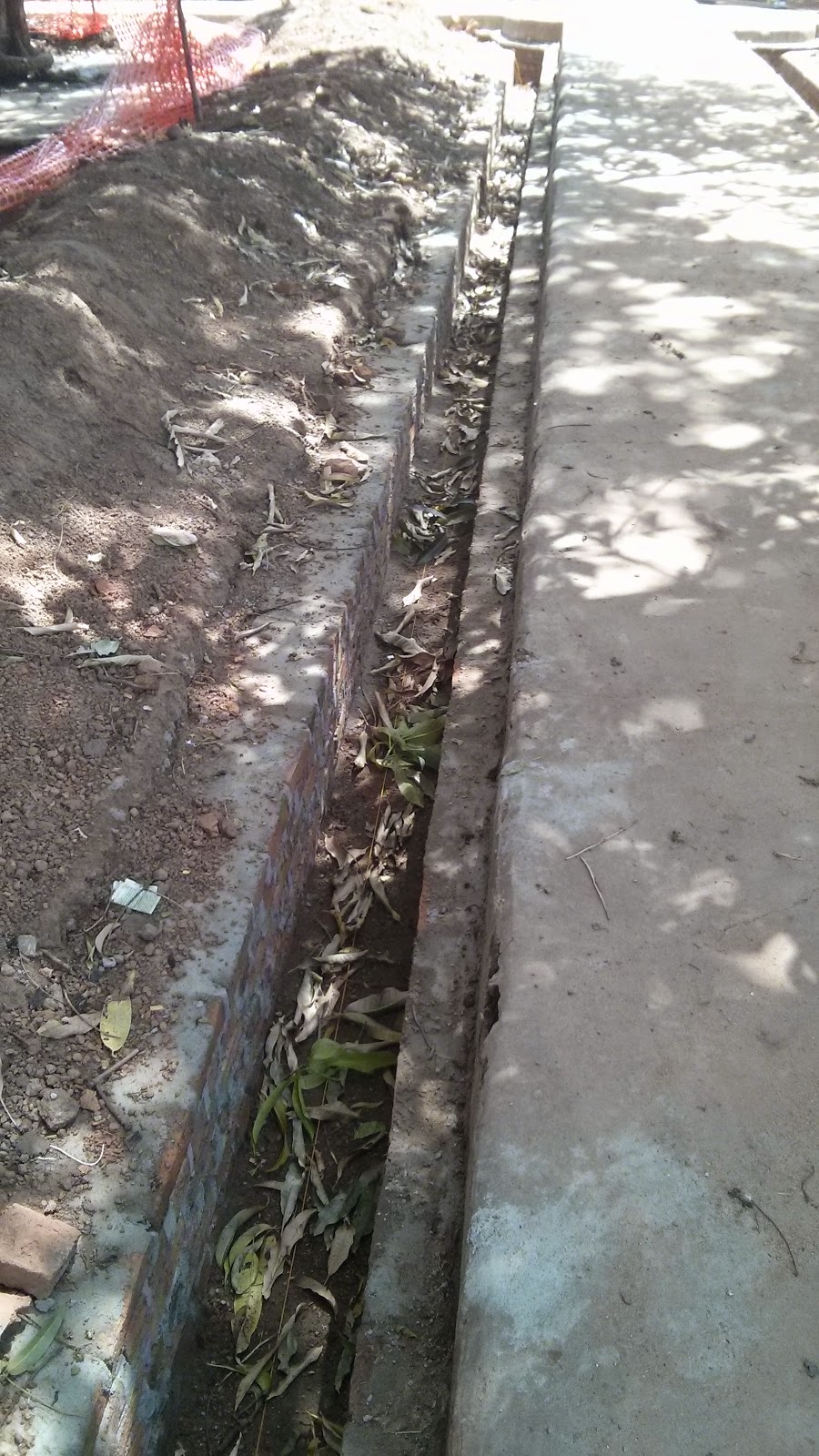
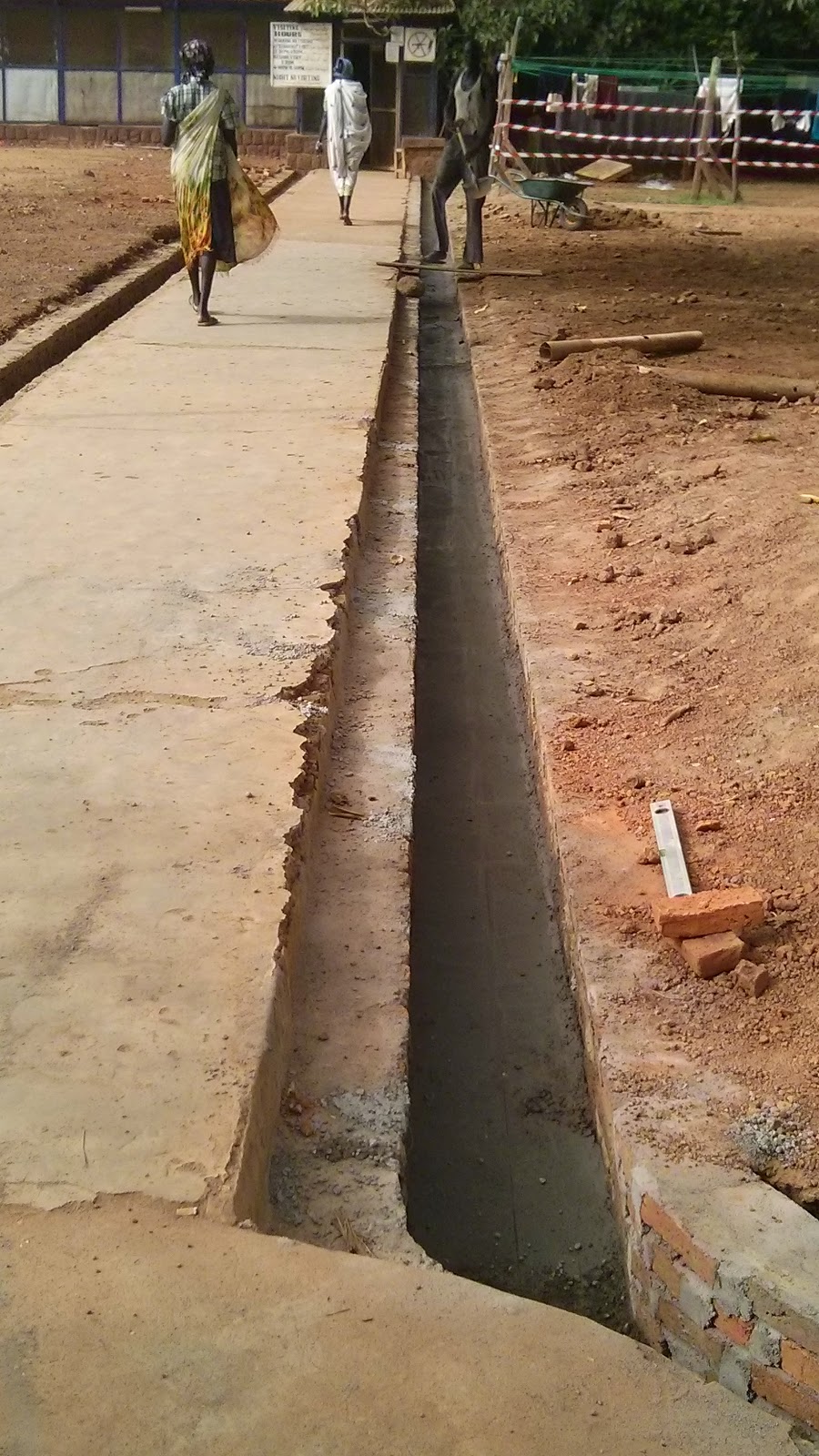
Drainage channel construction in the courtyard of the hospital.  Look at the channel.  I mean, really look.  This is why my slide shows stink.

Mmmmm, grease.  Cleaning out the grease trap, which was so disgusting I had to take a picture of it.  They're not usually this bad.

I needed to show the size of our gravel.

See where our percolation test hole is?  A picture is worth a thousand words.


We need this part for a land cruiser.


Our phase balancing for our warehouse generator.  I'm more worried about the low voltage output on phase 1.

Stumble Upon Toolbar

Sunday, May 24, 2015

Blood Bank

"Log Ref, Log Ref for Blood Bank."

"Go ahead for Log Ref."

"The log tag is alarming, over."

"Can you send it with a driver? Over."

"Can you come to see? Over."

"Yes, but later.  I'll be there a bit later.  Over."

"Affirmative.  Thank you, out."

This is not the conversation that I want to be having at 7:45am on Sunday, but with the pharmacist on his one-week R&R leave, I guess I'm the de-facto cold chain monitor-er.  We don't want to lose any blood units, and we've already had several cold chain breaks that threatened our blood stock.  We've changed out the fridge, so I'm confident that the fridge is OK.  I don't know what all the alarms are about, but I'll check anyway.

Stumble Upon Toolbar