After the EMT course, I wanted to head out to San Francisco to visit my brother. I didn't know how I was getting there, but I figured I could book a plane ticket once I figured out if anyone was going to be doing some hiking or backpacking. I had never been to Wyoming, so it would be nice to make it to Yellowstone.
But instead of heading to Jackson Hole or Yellowstone, I tagged along with a group of people going to Yosemite to hike up Half Dome. Close enough to San Francisco.We left Lander, WY on Friday after taking the national registry test. We headed south to Salt Lake City (which is quite near Wyoming, look it up), where we ate dinner, crashed a wedding and saw the Mormon Temple. As we headed out, we saw a thunderstorm over the Great Salt Lake, which was pretty spectacular. Right outside of the city is the desert. We headed out into the flat landscape as darkness fell, and hit Nevada just as our endurance flagged. We pulled off onto a dirt side road, then pulled off that and made camp.
Daylight came early the next morning, since it was a wide-open desert. There was nothing to block the light. No shade for miles, except the nearest casino, which was kept in a disorienting neon-lit semi-darkness. We hopped in the car and headed across the whole state of Nevada.
Nevada's not flat. It's full of spectacular landscapes with dramatic mountains and views across miles-long plains. It also has two big cities, and we were traveling in the direction of neither. The largest town we passed through was Tonopah, "The nation's #1 stargazing destination." Yeah, no civilization to get in your way of the night sky. We had lunch, got gas, and moved on.Once we hit California, the landscape became a bit more green. We were headed into the Sierras. We were checked for any citrus fruits (contraband!), then on our way past Mono Lake, toward Yosemite.
We got our passes at the visitor center at Mono Lake, then headed into Yosemite National Park from the east. The back entrance!
Our plan is to dispersion camp tonight, wake up early and hike Half Dome tomorrow. Then I'll bum a ride with a friend of a friend back to San Francisco for a brief visit with my brother. Then it's back to Philly to switch some luggage, pack some props, then Edinburgh for the Fringe Festival.
Saturday, July 10, 2010
Road Trip to Yosemite
Friday, July 9, 2010
Learning to be a Wilderness EMT
I'm a fan of being useful, and my latest endeavor to become more so is a course in wilderness medicine. It's a month-long intensive course that covers urban EMT curriculum, combined with the outdoors' own medicine practices. I'm taking it through NOLS, with their Wilderness Medicine Institute.
The course is located in remote Lander, WY, at the base of the Wind Rivers mountain range. It's in an outpost of the Central Wyoming College, at Sinks Canyon Center. There's no cell phone reception on site, but if you hike up the nearest ridge, you can usually get a couple of bars. There are trails to neighboring BLM lands (but don't go to the neighboring buffalo farm, a 'shoot-first' trespassing policy is in effect). There's a climbing wall, a volleyball court and a fire pit. We make good use of all of these.
There are 30 students in the class, ranging from high school students through to veteran antarctic safety experts. Everyone is very active and interested in the outdoors. There's a contingent of climbers, some avid Ultimate frisbee players, some volleyball enthusiasts and a bunch of hikers. Everyone shares their skills and gets everyone else in on their sport. It's a pretty ideal community. The staff here say that we're unique in our cohesion, especially for the duration (4 weeks gets to be a long time).
We're here to take a 180+ hr course in 4 weeks. We spend every day in class, from 8am to 5pm, with two evening sessions per week. We learn concepts in class, then head right outside to put them to use. By the end of the course, we've 'treated' 'patients' with a wide range of ailments, from lighting strikes to heart attacks, from altitude sickness to obstructed airways, from broken femurs to seizures. And then there were the big scenarios.
Interspersed throughout the month, there were large-scaled scenarios where multiple people would be injured in a plausible backcountry way (swept away in a flood, fell on a climbing accident, etc). We as a group would respond, stabilize everyone, and transport the patients. We as a group had great growth from our first chaos-ridden scenario to our final scenario. It was very rewarding to see the skills of our group as a whole grow. We became a rescue machine. Too bad it was all fake.
We've mostly all made it through the course. We're now (very expensively) trained wilderness EMTs, qualified to work on ambulances or in hospitals in the urban setting, or act as field medics in the back country. Subjected to mounds of red tape and protocols, of course. But we're qualified medical professionals. If at the bottom of the ladder.
Friday, June 11, 2010
Nomadic travel via airplane
Today I pack up my life again, into my car in that familiar routine. Everything has its place in bags, boxes, suitcases, etc, and every bag, box, suitcase or etc has its place in my car. It all fits, with room for sleeping.
Except I'll go drive that car to my parents' house, and leave it there. I'm getting on a plane for Wyoming tomorrow morning, and not reuniting with my car until September 3rd, a couple continents later. That means a change in my usual routine. I'm currently packing, having to streamline my already pared-down belongings into one suitcase. Not too bad. Maybe I can get rid of everything I don't bring, and then only have one suitcase of belongings... Maybe.
I'm off to become a Wilderness EMT. I'll be taking a month-long course at the Wilderness Medical Institute in Lander, Wyoming, a branch of NOLS. I'll be a nationally certified EMT-Basic, with a wilderness extension, to cover incidents with delayed response from regular emergency services. So I'll be learning to stabilize fall victims for a multi-mile pack out to an ambulance, move accident victims to avoid flash floods, get spinal cord injuries under shelter for the night, stop bleeding with backcountry first aid kits. And so forth. Because isn't that useful knowledge?
As Heinlein says, "A human being should be able to change a diaper, plan an invasion, butcher a hog, conn a ship, design a building, write a sonnet, balance accounts, build a wall, set a bone, comfort the dying, take orders, give orders, cooperate, act alone, solve equations, analyze a new problem, pitch manure, program a computer, cook a tasty meal, fight efficiently, die gallantly. Specialization is for insects."
Then it's off to Scotland, for the largest arts festival in the world, to coordinate all the technical aspects for Flesh and Blood & Fish and Fowl.
Monday, May 31, 2010
Back to the known
After my wrist was declared fully healed (nothing like a farm for rest and recovery), I pursued the cruise contract that was retracted after my accident. Well, it turns out that they have no openings for the 'near future'.
Well, that throws a wrench in my plans for working on a cruise ship. Time for plan B.
I can go anywhere in the world and do a wide variety of things. I'm back where I was nearly a year ago. Ok, I'll make an opportunity out of it.
I can teach horseback riding lessons in New Zealand, Italy, Argentina or the UK. I can lead troubled youth through wilderness therapy in the American Southwest. I can work in theater.
But I'm done with the farm life. Over three months of being in one place really got to me. It was time to move on.
Three days after the news from Princess Cruises, I got a concrete job offer out of the blue. Someone from Philadelphia wanted me to production manage a show going to Edinburgh, Scotland in August. There were no guarantees that I'd come to Scotland, but they needed someone in two weeks to help get things in order.
Great.
Back to Philly, where I have plenty of people to stay with, where I know the value of housing in different neighborhoods of the city. Familiarity with a city leads to a million conveniences that one does not particularly appreciate until one moves. Or until one moves around every few months in a consistently uprooted lifestyle.
So I'm in Philadelphia, production managing a show, preparing it to go to the greatest art festival in the world. And trying to find my next adventure.
Monday, May 10, 2010
Making a Road Trip out of it
I left Heifer Ranch on Friday. I had been there for over 3 months, which is a very long time for me to be in any one location or job, consistently, since I graduated college. I had done 3 months in the same apartment, but I had left on tour a few times while I was living there. No wonder I was getting antsy.
I was driving up to Columbia, MO, to visit a friend that I hadn't seen since high school. We had kept in touch consistently, using only phone conversations and phone messages. We became facebook friends and knew each other's email addresses, but we never resorted to electronic communication. We never resorted to written correspondence, either. It was a weird way to keep up a friendship, in this modern age, but it was unique, and it lasted.
So, being in the same time zone, and with a free chunk of time before my next job, I decided to drop in and visit. That meant an 8-hour drive up from Arkansas to Missouri (which is only the next state up). But an 8-hour drive is nothing compared to the epic 20+ hour drive from Philadelphia to across the Mississippi.
So I did the 8-hour drive in one day, packing all of my belongings on Friday morning (the standard 1-hour-pack-everything-I-own routine), said goodbye to a life of daily adventures, and hit the road. There were plenty of road-trip-esque attractions along the way (Super deep caves! Ozark Historical Museum! Lake Vacationstop!) that I rolled on by.
I was preoccupied by the landscape, watching the rolling Ouachita Mountains turn into the jagged Ozarks, which rolled into long plains before retreating back into more jagged Ozarks. I had to stop for gas, and figured a good place would be Springfield, MO, home of the flagship store of Bass Pro Shops, an outdoor store.
This particular Bass Pro Shop was their flagship store, and included supersized versions of everything they sold. A couple nascar racecars were on display. Their bait and tackle section included full-sized fishing boats, boat trailers, and even vehicles to pull them. If you wandered through the outdoor section long enough, you ended up in their hunting section. Good thing you passed the food court, where you could pick up a snack for the long trek back.
The place was decorated with hunting trophies, with stuffed deer heads coming out of every bit of wall space. They set up dioramas of bucolic outdoor scenes, complete with stuffed animals. Like, taxidermy. Not cute stuffed animals, but cute, stuffed animals (if you don't know the difference, I recommend learning the fine points of English grammar).
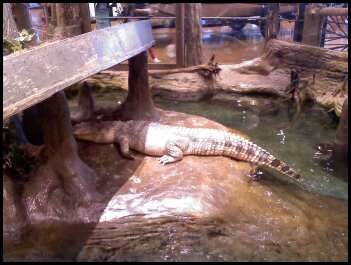
The highlight of the place, though, was the live alligator. Hard to beat.
Revitalized for the long drive, I headed out. I stopped briefly in Jefferson City for dinner and a glimpse of their beautiful State Capitol building, with beautiful views over the huge Missouri River right behind it.
I rolled on in to Columbia not too long after, and concluded my small first leg of another move. Eight hours is an easy drive, compared to what's to come next week.
Thursday, May 6, 2010
When Daily Life Is An Adventure: Chicken Chopping
Warning: Graphic content
We raise and process our own chickens here on Heifer Ranch. That means that when they reach 8 weeks of age, we slaughter them and prepare them for cooking in our kitchens. We wake up early one day and process all of the birds in one go. The day-long event is called "chicken chop" (or poultry processing--we're into alliteration here apparently).
At 5:30 in the morning, we transported the chickens to the chicken chopping room in one of our farm trucks. They all wait patiently in the back of the truck, quite content to peck around and lay down.
Each bird gets put in a metal cone with their head sticking out the bottom. We hold their heads, sight the cut, and use an extremely sharp knife to cut both main arteries and the windpipe in one swift, wrapping cut. We hold the head back as most of the blood drains out. The chicken convulses after it dies (as it's put in the cone and the cut is made, it's quiet and still; we try not to stress the birds).
We had three cones operating, allowing the first bird to bleed out by the time the third was killed. We then dip the carcass in hot (170 degree) water for about 15 seconds, to loosen the feathers. Then the head and feet are taken off and discarded.
The scalded carcass goes in our clever defeathering rig, which rotates the carcass around inside a barrel lined with rubber spikes, which catch and remove feathers. The rest of the feathers are plucked by hand (preparing chickens for eating is mostly defeathering, it turns out).
The bird is now ready to go inside. First, we remove the innards, taking out the intestines and the liver, etc in one giant mass. We try not to break the GI tract, since that would get manure inside the carcass. With the innards out, the front of the GI tract is ripped out, then the other end is cut off, along with the tail. The heart is also taken out (it hugs the sternum, keeping separate from the 'guts'). Lastly come the lungs, which are difficult to pry out, and the windpipe, which gets pulled out the front, at the base of the neck.
The gutting step was where I ended up doing most of the work. I got fairly proficient at it, and it was very systematic. There is very little cutting: just open up the carcass and cut off the tail, everything else is pulling.
I learned a lot about chicken (and animal) anatomy. Animals are amazingly good at using up all their inside space. The livers had rib indents from being pressed between intestines and rib cage. Lungs were plastered into the spine. The intestines were wound into a small, solid mass. The organs didn't look like textbook organs, in perfect rounded shapes with smooth outlines. They were jam-packed inside the little bodies in a crazy game of anatomical tetris. Pretty efficient. Pretty cool.
But it all came out and went into the discard pile. Once the carcass was gutted, it got passed down the line to be scrubbed out with a high-pressure water wand, then on down to be finely defeathered. Once someone double-checked for small pin feathers (the roots of feathers that get stuck in the skin), it was submerged in ice water to cool.
After lunch (yeah, we took a break and actually ate in the middle of this process. No chicken for lunch, though), we hung up the carcasses and cut them into quarters. We bagged the quarters (4 quarters to a bag) and stuck them in the freezer. We'll rotate them until they freeze solid, then they're ready to be distributed into kitchen storage.
Then defrost, cook and eat.
Now I know how to prepare chickens for the table. A great skill to have. I bet I can even apply that skill to other small animals, like rabbits and squirrels. Not that I often have a rabbit or squirrel to eat. But the option's there.
Thursday, April 15, 2010
When Daily Life Is An Adventure: Getting exercise
This is where I work.
A typical day in the livestock department starts at 7am and ends around 5:30 or 6pm. During the day, we get plenty of exercise in a variety of ways.
Biking to work gives me cardiovascular exercise.
Milking goats gives me a hand strengthening exercise.
Lifting buckets of grain into and out of a truck gives me weight training.
Walking behind cows on a mile-plus-long cattle drive gives me exercise.
Putting away a couple tons of feed gives me some more weight training.
Putting up and taking down temporary electric fencing gives me more walking exercise.
Pounding in T-posts gives me strength training.
Running after a calf that lost its mom gives me more cardiovascular exercise.
Keeping that calf in a truck to take it to its mom as it flails and struggles is more strength training.
A typical day in livestock is very active. My office has no walls. The last work-related phone call I received was to confirm that I was going to give three baby goats their bottles for the lunch feeding.